


The AI Jobs Debate Is a Fight About the Wrong Thing

Almost everyone arguing about artificial intelligence and jobs is arguing about a different thing, and mistaking it for the same thing.
Spend a week with the commentary and you will meet a dozen confident, incompatible verdicts. One says a white-collar bloodbath has already begun. Another says technology always creates more work than it destroys, so relax. A third says AI only changes tasks, not jobs. A fourth says the machines will make us all so rich that work becomes optional. They cannot all be right, and the temptation is to pick a side and defend it.
I spent the past several weeks doing something different. Working with a small salon of human and AI minds, set to challenge one another rather than to agree, I sorted the debate into ten recognizable camps and put each one to a simple test: what would have to be true for this position to stand, and what observation would prove it wrong? Then I checked each against the evidence as it actually stood in mid-2026.
The result surprised me less for who turned out to be wrong than for why everyone was talking past everyone.
The camps do not disagree about the facts nearly as much as they appear to. They disagree about which danger matters most.
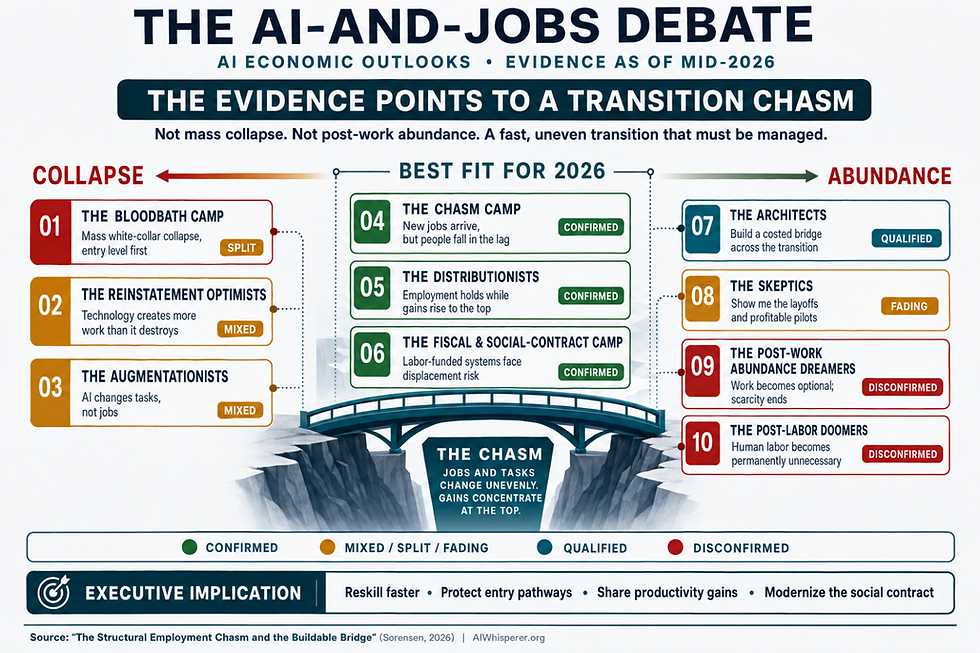
Here is what the data actually saw. Across the advanced economies, unemployment sat at 4.9 percent, squarely inside the band it has held since 2022. The forecast of immediate mass joblessness is, so far, simply wrong. Yet beneath that calm surface, entry-level job postings had fallen by more than a third, and by more than forty percent in the most AI-exposed roles, while young workers in those roles lost around thirteen percent of their employment relative to their older colleagues. The aggregate is steady and the bottom rung is breaking at the same time.
That is not a contradiction. It is the signature of what I have come to call the Net Employment Chasm, the gap that opens when tasks are destroyed quickly and new ones are created slowly. Jobs return, but not on the clock they leave, and the people who fall into the gap are disproportionately the young, trying to gain a first foothold.
Two further findings complete the picture, and both are confirmed. The newest economic modeling shows that AI can narrow the gap in wages while it widens the gap in wealth, because the returns to the machines flow to the concentrated few who own them. And a state that funds itself by taxing labor faces an eroding base at exactly the moment displacement raises the demand for public support.
So we hold three distinct risks, and they can all be true at once: a broken entry rung, a widening concentration of wealth, and a hollowing tax base. A society can reach full employment and still end up more unequal and less solvent. That is why the camps talk past one another. The Bloodbath forecaster fears the lost job. The Distributionist fears the captured gain. The Fiscal realist fears the empty treasury. Each is right about a different danger, and answering one does nothing to settle the others.
Once you see the debate this way, the useful question stops being who wins the forecast and becomes which of these risks you are carrying, and with what instrument.
A word on the most dangerous financial advice of the year.
You have likely seen the claim, offered from the very top of the industry, that you no longer need to save for retirement because AI will deliver an age of abundance and a universal high income. I would treat that counsel with great care. Cheaper production is not the same as distributed access. A promise that you will be provided for is not a transfer of ownership, and in all of economic history abundance has never once distributed itself. It was distributed, when it was, through institutions that had to be built, and only because the powerful still needed the many as workers and as customers. Notice, too, that the people most confident money is about to become irrelevant are the ones accumulating capital, compute, and land at record speed. Their revealed preference is louder than their forecast.
Which brings me to the part I care about most. I am not a doomer. I see in these systems an immense possibility for human flourishing, provided we build and use them within an ethical frame. The gap between what AI removes and what it restores is real and structural, and it will not close on its own. But a bridge across it is buildable, and a costed plan to build one can be judged rather than merely admired.
To make that concrete, I subjected one such plan, from my own book, The Great Reimagining, to an independent simulation of two hundred thousand scenarios, and I published where it holds and where it breaks. Its base case is affordable, its crisis provisions prove necessary rather than decorative, and its one real vulnerability is its dependence on how large AI's productivity gains actually turn out to be. I would rather tell you that honestly than sell you a soft landing.
That is the shift I am arguing for. Stop trying to win the forecast, and start treating AI and work as a portfolio of distinct risks, each with its own instrument. Protect the first rung, because the entry roles being automated are the stepping stones through which people once climbed to the senior work that AI cannot yet touch. Broaden ownership rather than tax it heavily, so the returns to the machines reach the many rather than the few. And rebuild the tax base deliberately, before the erosion forces the question under worse conditions.
Plans of this kind should be judged on their arithmetic, neither waved away as advocacy nor swallowed as gospel. Judging them is how the conversation moves from warning to building, which is where, on the evidence, it now needs to go.
The full working paper, "The Structural Employment Chasm and the Buildable Bridge," lays out all ten camps, the test each must pass, and the simulation in detail. I would genuinely welcome your disagreement. A claim earns its standing by surviving the attempt to refute it, and this one is offered in exactly that spirit.
Copyright © 2026 by Severin Sorensen. All rights reserved.


Comments