


The Two Waves AI Transformation

Updated: Dec 26, 2025
The conversation around AI often stalls at a simple question: "Will it replace us?" Research by Severin Sorensen suggests this binary is misleading. Instead, we are entering a two-wave transformation that moves from the digital desk to the physical world. For business leaders and executive coaches, understanding these waves is the difference between proactive growth and sudden obsolescence.
Wave 1: The Cognitive Evolution (2024–2030)
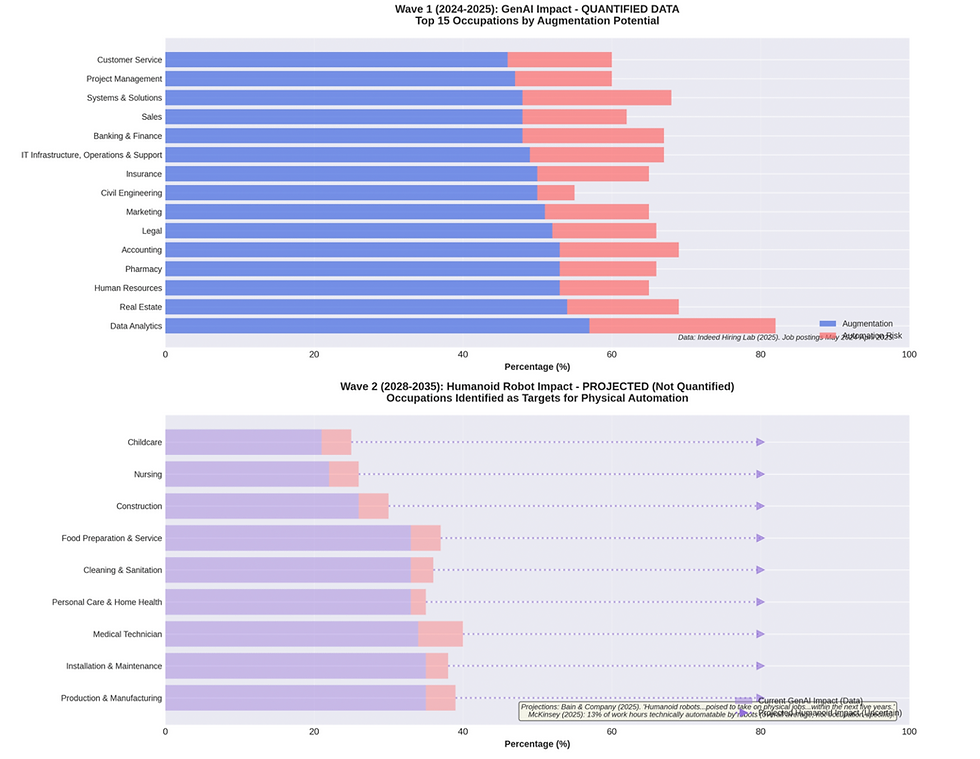
We are currently in the first wave, driven by Generative AI and Large Language Models (LLMs). Recent analysis of 52 major occupations shows AI is nearly four times more likely to augment human work than replace it entirely. On average, 43% of tasks in these occupations can be enhanced by AI, while only 11% face full automation risk.
Top 5 Most Augmentable Occupations in Wave 1:
Data Analytics: Leading the wave with 57% augmentation potential; AI handles complex data processing while humans focus on strategic "why."
Real Estate: Transforming with 54% augmentation potential; AI streamlines market analysis and administrative logistics while professionals focus on high-stakes negotiation and client relationships.
Accounting and Legal: With just over 50% augmentation potential, high-structure roles where AI automates document drafting and routine bookkeeping, leaving high-value judgment to professionals.
Project Management: With 52% augmentation potential, AI handles scheduling and reporting, transforming the manager into a high-level orchestrator of human and machine agents.
Analysis of 52 Major Occupations in Wave 1:

Wave 2: The Physical Disruption (2025–2035)
While Wave 1 targets the office, Wave 2 is the "tsunami on the horizon". Driven by humanoid robotics and embodied AI, this wave will reach a critical inflection point in the next 12 to 24 months as manufacturing scales up. This period means embracing a mindset of lifetime learning and mastering the human-AI collaboration skills that will define the future of work. The choice is no longer between adapting or not; it is between learning to use augmented AI tools or being replaced by them. The shore is still reachable, but the tide is coming in faster than anyone predicted.
Roles Targeted in Wave 2:
Nursing & Personal Care: Once thought "AI-resistant," these roles are primary targets for humanoid assistance in mobility and routine monitoring.
Construction: Humanoid systems will add precision and strength to physical labor, moving these roles from "manual work" to "robotic supervision.”
Childcare: Physical care roles with low current GenAI impact are deceptive "blind spots" now being prioritized by the robotics industry.
Food Preparation & Hospitality: From Michelin-star quality robotic chefs to automated facility management, the physical service sector will see rapid transformation as robots reach cost-parity with human wages.
The Two-Wave Transformation Timeline
Strategic Guidance: Move to "Higher Ground"
The report introduces an adaptation of the Eisenhower Matrix to help leaders categorize their workforce:
Quadrant I: Strategic Augmentation (High Augmentation, Low Automation)
Occupations: Legal (LG), Project Management (PM), Marketing (MK), Human Resources (HR)
Profile: Complex, creative, and strategic roles where GenAI acts as a co-pilot.
Strategic Imperative: Invest heavily in AI tools and upskilling to create a temporary competitive advantage. The focus is on enhancing human judgment, not replacing it.
Quadrant II: Transformative Augmentation (High Augmentation, High Automation)
Occupations: Data Analytics (DA), Accounting (AC), Software Development (SD)
Profile: Structured, data-intensive roles where AI can both augment and automate significant tasks.
Strategic Imperative: A mixed strategy is required. Automate routine tasks while upskilling the workforce to focus on higher-value analysis, validation, and strategic oversight.
Quadrant III: Automation Risk (Low Augmentation, High Automation)
Occupations: (Few occupations fall here, indicating most high-automation roles also have high augmentation potential)
Profile: Routine, predictable cognitive tasks.
Strategic Imperative: Focus on reskilling and transitioning the workforce to roles in other quadrants.
Quadrant IV: Wave 2 Targets (Low Augmentation, Low Automation)
Occupations: Nursing (NU), Construction (CN), Childcare (CH), Food Preparation (FD)
Profile: Physical, manual, and care-based roles with low current GenAI impact.
Strategic Imperative: Monitor humanoid robot development closely. The low current transformation is deceptive; these are the primary targets for Wave 2. The focus should be on long-term workforce planning and identifying new human-centric service roles.
The Main Takeaway
While some argue that AI will eventually become a non-differentiating utility like electricity (favoring a "fast follower" strategy), high-augmentation sectors such as Legal and Data Analytics offer a distinct first-mover advantage. By moving early, organizations can build "temporary moats" through proprietary workflows, fine-tuned models, and superior AI literacy, capturing a critical 3-5 year competitive window. Ultimately, leaders must use this period of high-augmentation potential to solidify the human-centric elements that AI cannot replicate, such as organizational culture and creative judgment, which serve as the only truly sustainable long-term advantages.
Copyright © 2025 by Arete Coach™ LLC. All rights reserved.


Comments