


Meet the Forward Deployed Engineer

Many organizations still struggle to translate the promise of artificial intelligence into measurable business results. The technology’s potential has been made clear, but its impact often remains trapped in pilot programs, unintegrated tools, or isolated innovation labs.
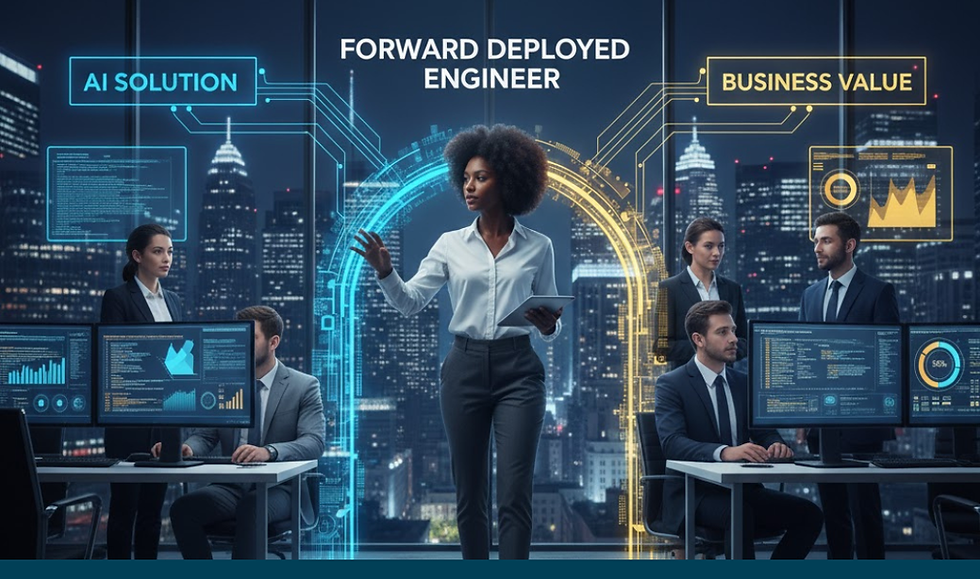
One emerging solution is the Forward Deployed Engineer (FDE): a hybrid professional who bridges the critical gap between data science and business execution. Rather than working in isolated technical teams, FDEs embed directly within business units, translating strategic goals into technical reality. Their presence ensures that AI initiatives move beyond experimentation to deliver measurable impact.
The FDE is not a universal solution; however, for organizations whose success hinges on complex, custom integration, investing in this role can redefine how they integrate, scale, and ultimately benefit from AI.
What is a Forward Deployed Engineer?
Imagine a highly skilled engineer who not only understands the intricate workings of complex AI models and platforms but also possesses the business acumen to translate that technical power into real-world solutions. An FDE acts as the critical liaison between your internal teams and external AI solutions or even your internal AI development efforts.
They are embedded within your business operations, working directly with stakeholders from sales, marketing, operations, and product. Their primary objective is not just to build or integrate AI, but to ensure that the AI solutions directly address your specific business challenges and opportunities. They identify pain points, understand workflows, and then adapt or configure AI tools to fit seamlessly into your existing ecosystem.
Think of them as the "boots on the ground" for AI: deeply technical, yet deeply integrated into the business fabric.
The Problem FDEs Solve
The traditional approach to AI implementation often looks like this: a centralized AI team develops a solution, which is then "handed off" to business units. This often leads to significant integration challenges, especially when complex AI must interface with legacy systems or diverse client architectures. This failure to bridge complexity often results in:
AI solutions that don't quite fit the specific needs of the business unit.
Teams don't understand how to use the new tools or see their immediate value.
Powerful AI capabilities languishing because they aren't effectively integrated into workflows.
The promised benefits of AI taking too long to materialize, leading to frustration and skepticism.
FDEs dismantle these barriers. By being forward-deployed, they gain an intimate understanding of the operational realities, enabling them to:
Tailor AI to deliver maximum impact for specific use cases and bespoke implementation needs.
Accelerate integration of AI tools into existing systems and processes.
Drive user adoption with hands-on support and training for non-technical teams.
Channel operational insights back to AI development teams, fostering continuous improvement and innovation.
Key Use Cases for a Forward Deployed Engineer (FDE)
The FDE's primary value is solving the "last-mile problem" of complex technology adoption. In other words, the gap between a working product in the lab and a successful, valuable solution in a messy real-world business environment.
Here are four critical scenarios where embedding an FDE translates AI potential into business outcomes.
Complex AI Integration
When deploying large language models (LLMs) or complex machine learning systems. The FDE embeds to securely connect the model to the client's proprietary data, APIs, and legacy workflows, ensuring the AI is "grounded" in business reality. For example, integrating an LLM-powered fraud detection system into a bank's 30-year-old transaction processing infrastructure.
Rapid Prototyping & Discovery
When the client knows they have a problem but isn't sure of the solution. The FDE quickly scopes, builds, and deploys a Minimum Viable Solution (MVS) in days or weeks, allowing the client to see value and provide real-time feedback. For example, a logistics company wants to optimize shipping routes; the FDE rapidly prototypes a routing agent using the client's live data.
High-Stakes Deployments
For mission-critical or highly regulated environments where failure is extremely costly. The FDE provides an elite, hands-on, dedicated technical owner responsible for making the deployment succeed and maintaining stability. For example, deploying a data-analytics platform for a defense or intelligence agency, as pioneered by Palantir.
Product-Market Feedback Loop
For companies that sell a platform (like an AI framework or data pipeline tool). The FDE gathers field signal—insights on what customers are actually trying to build—and feeds it directly back to the core product team, influencing the product roadmap for scalability. For example, an FDE learns that ten different clients are building the same custom data connector, leading the core product team to build it into the platform.
Why FDEs are the Number One New AI Hire
The demand for FDEs is exploding, particularly with the rapid advancements in Generative AI. For enterprises trying to move complex AI from proof-of-concept to production reality, the FDE has become the critical link. This realization is driving unprecedented growth in the role, with job postings for the Forward Deployed Engineer (FDE) increasing more than 800% from the start of 2025 through September, making it one of the fastest-growing job titles in the enterprise software sector (Bregel, 2025).
Does Every Organization Need FDEs?
No, not every organization needs a dedicated FDE team. The need for FDEs is directly proportional to complexity and the need for bespoke implementation. If your business is selling or adopting technology that requires significant, custom, hands-on integration to work effectively in a customer's specific environment, the FDE model is a strategic unlock. If the product is mostly plug-and-play, it's overkill.
Organization Type | Need for FDEs | Rationale |
B2B AI/Platform Vendors | High/Critical | The FDE is the go-to-market strategy. They ensure their complex, evolving product (like an LLM or a data platform) delivers value across diverse customer environments (like a bank vs. a manufacturer). |
Large Enterprise/Government | Moderate/High | They need FDE-like talent (often called "Applied AI Engineers" or "Embedded Solutions Leaders") to integrate new AI tools into their vast, complex, and slow-to-change internal systems. |
Agencies / System Integrators (SIs) | High (Project-Based) | FDEs are hired to ensure successful project delivery and overcome the "last-mile" integration challenges for their clients. They provide specialized, high-impact talent on a temporary, contract basis. |
SaaS with Simple Onboarding | Low | If your product is a self-service tool or has standard, low-customization APIs, a traditional Solutions Engineer or robust documentation is sufficient. |
Small-to-Mid-Market (SMB) | Low | SMBs generally lack the complex, bespoke integration needs that justify the cost and dedicated resources of an FDE. |
Hiring Strategy
The hiring strategy depends entirely on whether you are the vendor selling the solution (and thus own the FDE model), an enterprise adopting the solution, or an agency.
Hiring FDEs from the Outside (The Vendor/Platform Model)
This is the classic FDE model pioneered by companies like Palantir and now adopted by OpenAI, Anthropic, and Databricks.
Who: The company that sells the platform or AI product.
Why: The FDE is a product specialist who knows the vendor's tech intimately and can deliver a working solution quickly. They are responsible for making the product a success in the customer's eyes.
Talent Profile: Must be a hybrid engineer—capable of writing production code (technical depth) but also highly empathetic and communicative (customer-facing skills).
Internal FDEs (The Enterprise/Adopter Model)
This approach is for large organizations that want internal teams to adopt new, complex technology.
Who: An internal IT or business transformation department within a large company (e.g., a bank or major retailer).
Why: To ensure that internal teams aren't relying on outside consultants forever. They build internal capability and transfer knowledge by embedding applied engineers into business units to drive adoption.
Talent Profile: Often sourced from high-performing developers or solutions architects who have strong domain expertise in the company's core business process.
Agencies / Professional Services
The role of agencies and professional services is rapidly evolving due to the FDE trend.
Agency Fit: Large System Integrators (SIs) like Accenture or boutique AI consulting firms are increasingly using FDE-like models to ensure successful AI delivery. They effectively rent out FDE talent on a project basis.
Key Distinction: The traditional consulting model is often based on time and materials or deliverables (reports/specs). The FDE model, whether internal or external, is focused on delivering tangible, working outcomes and product feedback—a much higher standard of accountability and technical skill than a typical consultant.
Conclusion: Agencies are well-suited for temporary, high-impact projects or for companies that cannot afford to hire a full-time, high-salaried FDE. However, the best product feedback loop is always achieved when the FDE is an internal employee of the platform vendor.
Integrating FDEs
Suppose your analysis shows that your organization's AI initiatives require this level of complex, bespoke implementation. In that case, your next step is not just to hire an FDE, it's to structure your organization for their success. Here are considerations for CEOs and executive leaders that maximize the return on this critical role:
Prioritize the Role: Recognize the FDE as a critical, high-impact position.
Empower Them: Give FDEs direct access to business units and decision-makers. Their insights are invaluable.
Invest in Their Development: FDEs require a unique blend of technical prowess and soft skills (communication, problem-solving, empathy).
Integrate Their Feedback: Establish clear channels for FDEs to provide feedback to your core AI development or procurement teams.
The Main Takeaway
The ability to effectively deploy, integrate, and optimize AI-powered tools is the ultimate differentiator. While not every company requires an FDE, for a platform vendor, an enterprise facing deeply embedded systems, or an agency leading custom transformation, the FDE is a strategic necessity for maximizing AI investments. The Forward Deployed Engineer is the catalyst for turning AI potential into measurable business value, acting as the critical bridge that transforms abstract code into operational profitability.
References
Bregel, S. (2025, November 5). Postings for this AI job are up 800%. Fast Company. https://www.fastcompany.com/91435680/postings-for-this-ai-job-are-up-800
Copyright © 2025 by Arete Coach™ LLC. All rights reserved.


The Forward Deployed Engineer concept really clicks with me, especially how they bridge that gap between AI potential and actual business results. It's like having a strategic player who knows both the tech and the operational side. For anyone looking to unwind after diving deep into complex AI integration strategies, Santa Clicker offers a fun seasonal escape where you can manage your own workshop and watch your productivity grow, one click at a time.
The role of Forward Deployed Engineers is crucial in translating AI's potential into actionable results for businesses, ensuring that technology aligns with strategic goals. Check out this Gothic 1 Remake for a creative take on bridging gaps!
The terrain in Geometry Dash Wave is often very narrow, full of sharp spikes and complex pathways, making control much more difficult than in other modes.